
"You need your ridge capping rebedded." "No, it just needs repointing." If two roofers give you two different answers, you are not alone. The two jobs are related, but they are not the same, and choosing the wrong one can waste your money.
This guide explains the difference between rebedding and repointing (also written re-bedding and re-pointing), how to spot which one your roof needs, and what to check in a quote.
Short answer: repointing renews the flexible pointing on top of the ridge capping when the bedding underneath is still solid. Rebedding lifts the caps, removes the old mortar and re-lays them on fresh bedding, then repoints. If the bedding has failed, repointing alone won't last.
First, what are bedding and pointing?
On a tile roof, the ridge and hip capping are the angled tiles that run along the top of the roof and down the corners. Two layers hold them in place and keep water out:
- Bedding: the mortar (cement and sand) or flexible bedding compound under the caps that fixes them to the roof
- Pointing: the finishing seal over the joints, where the caps meet the tiles. Today this is usually a flexible pointing compound, available in colours to match your roof
Over time, sun, heat, rain and movement break these down. When they fail, water can get in right along the highest line of your roof.
Repointing vs rebedding at a glance
| Repointing | Rebedding (then repointing) | |
|---|---|---|
| What it fixes | Cracked or worn surface pointing | Failed or crumbling bedding, loose or shifted caps |
| What's involved | Remove loose pointing, clean the surface, apply new flexible pointing | Lift the caps, remove old mortar, re-lay the caps on fresh bedding, then point |
| Suits roofs where | The caps are solid and still in a straight line | The caps move, sit crooked or the bedding has broken down |
| If you choose wrong | You pay for work you didn't need | The new pointing can fail early because the base underneath is loose |
Signs you may only need repointing
- Cracks or small gaps in the pointing
- Faded, chalky or flaking pointing
- Small pieces of pointing in your gutters
- The caps feel solid and sit in a straight line
Signs you probably need rebedding
- Caps that are loose, wobble or have shifted out of line
- Missing or broken caps
- Large gaps, or mortar crumbling away
- Sand or mortar grit building up in your gutters
- Leaks or stains on the ceiling under the ridge
Only an inspection can tell you for sure. A good roofer checks whether the caps are solid before recommending a scope, rather than quoting from the street.
What each job involves
Repointing
- Inspect the ridge and hip capping and check the caps are solid
- Remove loose pointing and clean the surface so the new pointing can stick
- Apply new flexible pointing along the joints, in a colour to suit the roof
- Check the drainage gaps (weep holes) are still open
- Clean up and clear the gutters
Rebedding
- Inspect and mark the sections that need work
- Lift the affected caps
- Remove the old, crumbling mortar and clean the area
- Re-lay the caps in a straight line on fresh bedding
- Once the bedding sets, apply flexible pointing over the top
- Replace any broken caps, check weep holes and clear the gutters
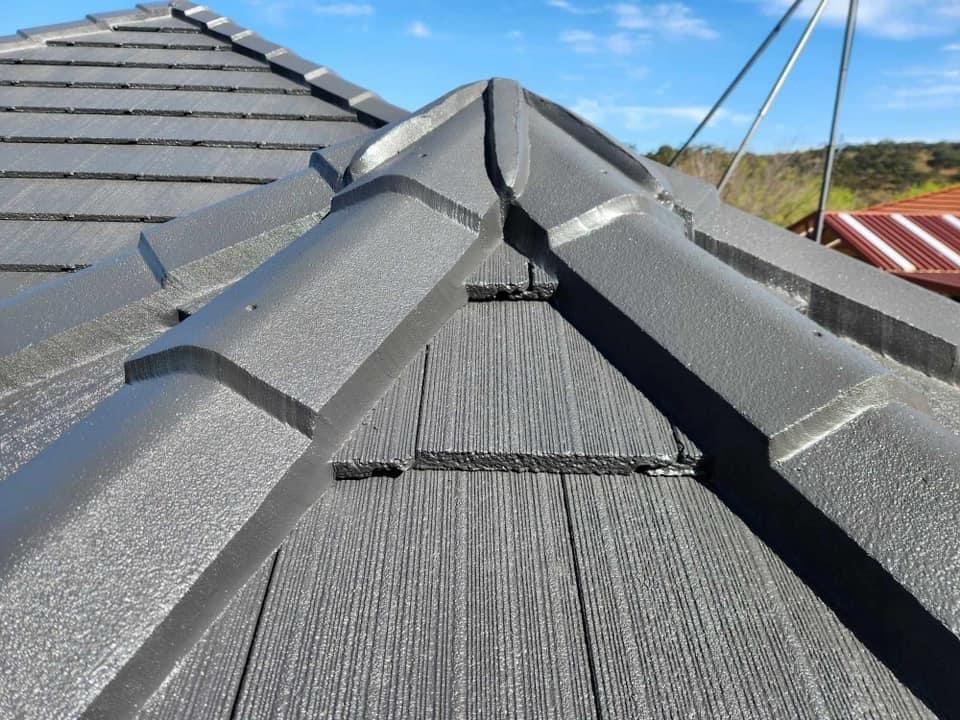
Ridge and hip capping meet here. This is the highest line of the roof and the first place to check.
Flexible pointing vs old cement pointing
Traditional cement pointing is rigid. As the roof heats up in summer and cools down at night, it moves slightly, and rigid pointing cracks. Flexible pointing is designed to move with the roof, which is why it is the standard choice today.
One important catch: flexible pointing can't make loose bedding solid. If the caps underneath are moving, new pointing on top will crack again. That is the main reason rebedding is needed in some cases.
Don't forget the weep holes
Small drainage gaps called weep holes are left in the pointing along the ridge so water that gets behind the capping can escape. They are provided for in the Australian roof tile installation standard (AS 2050). A careless repointing or painting job can cover them over, so ask your roofer to keep them open.
Repointing, rebedding and roof painting
If you plan to paint or restore the roof, ridge repairs come first. Pointing and bedding should be sorted before any coating goes on, so you are not painting over a weak point. See our roof painting and roof restoration services.
How to compare quotes
A useful written quote should state:
- Whether the work is repointing, rebedding, or both
- Which sections of ridge and hip capping are included (and roughly how many metres)
- Which pointing product will be used
- Whether broken caps will be replaced
- That weep holes will be kept clear
- What clean-up is included
Be wary of one lump-sum price for "the whole roof" with no inspection and no breakdown.
Should you do it yourself?
We don't recommend it. Working at height on tiles is dangerous, tiles crack easily underfoot, and pointing only lasts if the surface is prepared properly. It is a job for an experienced roofer.
Get a free ridge capping inspection
If you can see cracked pointing, loose caps or mortar in your gutters, get it checked before the next big storm. We give a free onsite quote with a clear written scope, so you know exactly what is included. Book the same day as your quote and take 10% off.
See our repointing service, or get your free quote or call 0434860035. For active leaks, see our emergency roof repairs and roof repairs. You can also browse our completed jobs or find your area.
Frequently asked questions
What is the difference between rebedding and repointing?
Repointing renews the flexible pointing on the surface. Rebedding lifts the ridge caps, replaces the old mortar underneath and re-lays the caps, then repoints over the top.
Can I just repoint my ridge capping?
Yes, if the caps are solid, straight and the bedding underneath is still sound. If the caps are loose or the bedding is crumbling, repointing alone will not last.
How do I know if my ridge capping needs rebedding?
Loose or crooked caps, missing caps, large gaps, crumbling mortar and mortar grit in the gutters are signs the bedding has failed. An inspection will confirm it.
Is flexible pointing better than cement?
Flexible pointing moves with the roof as it heats and cools, so it is less likely to crack than rigid cement. It still needs solid bedding underneath.
Will repointing stop my roof leaking?
If the leak is coming through failed pointing, yes. Leaks can also come from cracked tiles or flashing, so a proper inspection finds the real cause first.
Can I paint over old pointing?
No. Failing pointing should be repaired or replaced before any coating is applied, otherwise the paint can crack and peel with it.